
Along with a fancy camera, there’s another tool that’s equally important for any photographer: photo processing software. In my early days of shooting I used Photoshop exclusively, and fixed and saved photos one at a time. In the mid 200’s, Apple and Adobe came out with products that were designed to catalog and process photos in batches, so that a photographer could download a couple hundred shots from a camera and quickly browse through them all for the best picks.
Apple’s Aperture was a great product during the years they supported it. From a UI/UX standpoint, it was incredibly intuitive to use as a beginner, and only offered tools as the user gained experience. I used it happily and built several fast, powerful workflows to process photos—especially handy when I was shooting daily. It was discontinued in 2015 and I used it for several years afterward until I was forced to switch to Lightroom. I had nothing but praise for the frontend of the application, but but the filing job it did behind the scenes was so fucked up I’m only now digging out of the hole it put me in.
Two weeks ago I bought an enormous 8TB NAS drive for our basement server and consolidated all of our photos to the new drive. This included an existing 4TB photo drive and two external drives I’ve had bumping around my desk for three years (shame on me). Most of that work involves manually moving photos into properly organized folders. This is, in practice, as boring as it sounds, and should have been done years ago.

See, the way that Aperture did things for a while was to dump photos into a dated folder not based on the date the batch was taken but the date it was imported. Sometimes it split photos up, out of order, and put them into subfolders with long date-stamped names—sometimes 30 or more folders in one main folder, and most often empty. Later, after an update, it stuck random photos in successively named folders called “Roll XXX”, with no connection to date or batch.
What I want is to catalog photos by each year, month, and day they were taken so that I can see a photo from a particular batch without depending on photo processing software, and so that I can tell immediately if I’ve got multiple copies of a photo on the same drive (something else Aperture liked to do). There were a couple of cases where I had five or six copies of the same batch of photos for no reason.
So, I’m going through each year’s folder and splitting out the months and days and re-filing everything, and it’s taking forever and giving me carpal tunnel syndrome as well as a satisfying sense of accomplishment, because when this is done, I’ll have a real sense of what’s here and what’s missing—and then I can go and look for the missing files in my binders of DVD backups.

Sadly, two of my beautiful Chef’s Choice tomatoes developed blossom end rot over the weekend, so I have to use my spray and hope I can save the rest of the fruit. Clearly there’s more research I need to do on what needs to be added to the soil to prevent this; it’s been a year-over-year problem that I haven’t licked yet. The other plants look extremely happy, however, and there are dozens of cherry tomatoes growing ever larger on the vines. I’ve been extremely aggressive at pruning the plants back this year, so walking in to the greenhouse and seeing 1/4 of the volume of plants vs. last year is still surprising.
My Fuji XT-10 apparently doesn’t like my new iPhone for some reason—or from what I’ve been able to find out, the Fuji app on the phone doesn’t like to talk to the camera. My iPhone 6 worked fine, albeit slow, but I could at least fire up the wireless connection on the camera and quickly transfer images to my phone. From what little I can glean, Fuji doesn’t seem to give a shit, there are issues with iOS 13, and there’s no telling when it’s going to be fixed.
Here’s your humor for the day:
Not that I need this, but I’ll save the link here: Fujifilm released software that allows the use of X-series cameras as webcams. I’d imagine you’d need a DC adapter to really make this work, as the batteries would drain in minutes, but it’s kind of cool. Update: I jut noticed it’s only compatible with the high-end X-series cameras and not my X-T10. Oh, well.
OK, so the folks that came up with a digital back for medium-format cameras now have a Kickstarter for a limited set of 35mm cameras: the I’m Back is a kit that bolts to the back of a film camera and provides a 2″ touchscreen display, 14MB RAW files, and as much storage as you can stuff into a Micro SD card. As I would expect, none of the cameras I own are on their list of supported models, but I’m going to wait and see if someone mods a Minolta x700 or a Fujica AX-3 and then maybe consider one of these.
A giant box was delivered via FedEx on Friday, containing a kit with everything I’d need to digitize slides. I ordered the baseline gear required: a Nikon D500, a 40mm macro lens, and the slide carrier kit, and set it up in the den on Friday night to start fooling around with it.
In about five minutes I was oriented with the camera and set up live view with the viewfinder, but on the first night I stuck with autofocus to see how good it would be. The results were OK; I’d say about one half of what I shot was in clear focus, but the other half was not. The color varies from slide to slide, mostly because Dad was switching film stock pretty regularly—the Kodachrome stuff is rich and clear, some of the Fuji is washed out or shifts to yellow/green on the color wheel, and there are other nonbranded film stocks that veer towards muddy grays and blues.

This makes processing it challenging, because my intent is to always bring each photo back to a normal white balance and exposure—and with Dad shooting a manual camera, the exposure could be all over the place. It’s amazing what kinds of detail I can pull out of a dark slide transfer when it’s shot in RAW format; I’ve been able to resurrect some shots that would ordinarily be past saving. In the 80’s, before he bought a newer Minolta, he was having problems with the light meter on his Konica, and I remember him grumbling about some of the slides we got back before he got it fixed. And, his insistence on either using a giant blinding light bar or facing subjects directly into the sun messed up some otherwise good pictures.
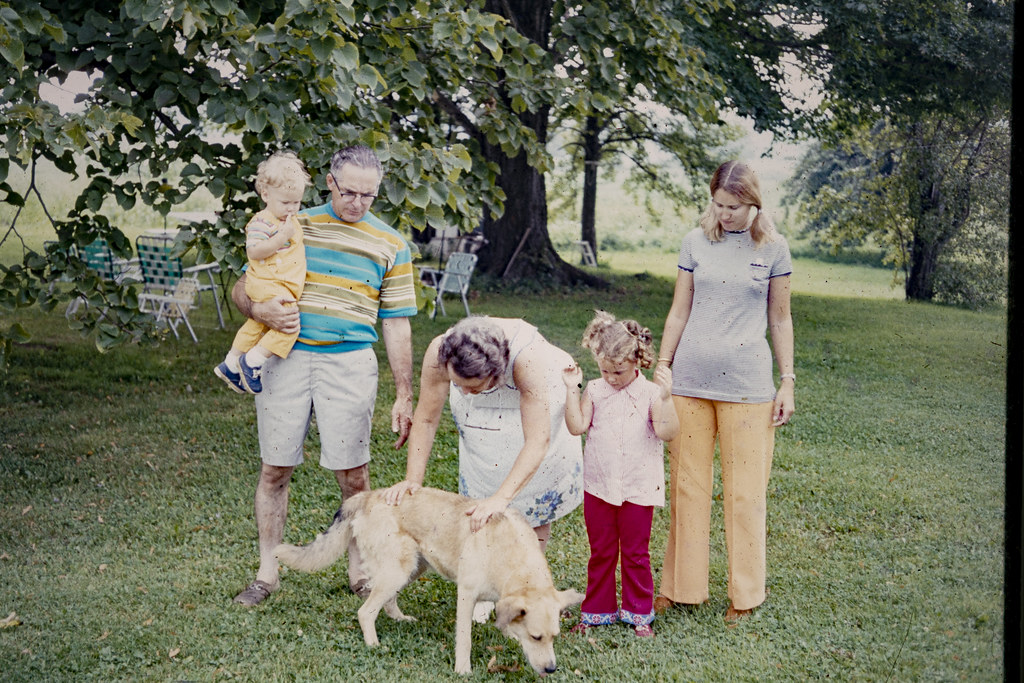
Sharpness is also a challenge, so last night I switched to shooting using manual focus and Live View on the camera to zoom in and correct the shot before hitting the shutter. This resulted in better, clearer pictures, and they were much sharper that was I was getting applying software fixes in post processing. The shots are all 20MP in size, which gives me plenty of data to clean up dust and scratches—and some of these are in rough shape.
I’ve made it through four carousels and a binder so far. I’d estimate that’s about 600 slides of an estimated 4,000, and I’m going to redo half of the 600 now that I’ve got a better focusing system in place. I have to adjust the lighting as well—I’ve got a better, brighter photo bulb I can use to bring out more detail.

Seen on the way to snowboarding last week: Darth Maul really wants me to pray on the subject of facial tattoos and long-haul trucking, apparently.
Thus begins Day Three of self-imposed quarantine at home. Normally I would pooh-pooh the hand waving and sensationalist headlines and continue on with life as normal, but because my blood cell counts are still below normal we’re not taking any chances. We’re stocked up on perishable goods and supplies for a two-week shut in, but we’ll wait and see how long this thing drags on. WRI has been awesome in supporting our individual decisions on remote work, and I’ve been making ample use of teleconferencing software to join meetings. I’m also trying to get the Annual Report laid out between meetings, which is much easier to do when I’m not at my desk and being pulled away for this or that.
PetaPixel just ran an article about digitizing slides and film with the Nikon adapter I’ve been looking at, and it got me to thinking: I’m trapped at home, what better time to try this out? I’m not going to shoot all 4,000 of the slides we’ve got, but I know 1 in 4 are probably worth digitizing. So I set up a rental for a 7-day span starting over the weekend to get to work.
Petapixel had an article on a Kickstarter project that’s building a tiny light meter for film cameras, small enough to clip into the hotshoe and stay out of the way, while providing immediate info for shooting. It’s a little under $100 at the time of writing, but I think I’m going to keep an eye on it for the future—this would be exceptionally handy to have.
When you support free, you support billionaires. When you pay, you support sane businesses and real creators. Start paying for things that cost money. If you can’t afford to, use fewer things, which generally make you happier anyway.
This is a long, but very well written article on Flickr’s SmugMug’s recent plea for help to find more paying users, and its future. TL;DR: It’s not going anywhere, but they need to double down on their core audience.
John Margolies was an art historian and critic who traveled America and took photos of signs he saw along the side of the road. His collection, almost 40 years’ worth of work, was purchased and donated to the Library of Congress, who digitized the negatives and have now lifted all copyright restrictions on the photos.
As a student of design and a fellow enthusiast, this is like a bucket of dopamine injected straight into my cerebral cortex.
Two Wednesdays ago, the day I was rushing around trying to focus on work and also get organized for Ohio, I got a giant, heavy package via UPS delivered to the door. I opened it up to reveal a carefully wrapped group of antique cameras and a lovely note from my cousin Margaret (who, I believe, lurks here but has not commented). These were her father’s film cameras, and as they were gathering dust at her house, she thought she would send them along to me.

They are all beautiful cameras but by far my favorite is this one: a Zeiss Ikon Ikoflex, a twin-lens reflex model manufactured by Zeiss sometime between 1934 and 1939, according to this website (the shutter lens assembly is from an earlier model and the body is from a slightly later model, so my guess is that someone fixed this one by combining parts from both). It’s both a long way away from my Rolleicord/Yashica TLRs and very similar; the focus wheel is actually a lever mounted on the side, but all of the wind/shutter/aperture controls are exactly where I expect them. I cleaned up the optics with a damp cloth, dusted out the inside, and made sure the mechanicals all work.

Then there was a box in perfect shape that held a Kodak Senior Six-20, a medium-format bellows camera from the late 1930’s. All of the original sales material is included, and the camera looks like it was just pulled off the shelf of a Woolworth’s or Sears & Roebuck by a guy in a bowtie and shop apron; the leatherette is unmarked, the bellows is pristine, and the mechanicals are flawless. When I look at the packaging and design of this piece I think of modern-day Apple: the design is excellent and of its age, there isn’t anything on the package that doesn’t need to be, the craftsmanship of the package and camera is exquisite, and it feels like an event to open the box. I could put this next to an iPhone box from the modern day and they would be father and son.

The next is a Minolta A.2 35mm rangefinder from somewhere in the late 1950’s, an absolute beast of a camera that probably weighs 35 lbs. It’s also in excellent shape and the mechanicals check out as far as I can tell. It’s enclosed in a leatherette case that probably adds another 10 lbs. to the whole package. How did people travel with stuff like this back in the day? My neck would snap like wet twigs if I had to haul this thing around Disneyland for a weekend.
There was a Revere Ranger 8mm winding cine camera, which is actually heavier than the Minolta. I think this thing was chiseled out of pig iron. It’s finished with that marbleldy texturing that was popular in the 1950’s for things like movie projectors and electronic equipment, and it feels solid as a brick in my hands. It’s actually the second of these that I’ve got: My Dad had one of these in the stash I bought back in 2002, and I’m curious to put them side by side to see if there are any differences. This one has a set of interchangeable lenses, which is kind of cool for its day.
Finally, there’s a General Electric exposure meter in a small velvet pouch. The pictures make it look really cool, like it’s an instrument that was pulled from the control panel of a DC-3. Unfortunately it’s jammed into its case, a half-box made out of bakelite, I’d guess, and I can’t seem to get it out. I’ve got to do some research on how to extract it without ruining the material.
Margaret, these are all wonderful timepieces, and I really appreciate your gift. I’m going to put them in a place of honor here on the Photography Wall, and I’m definitely going to put some film through the Zeiss—as soon as I finish the roll in the Yashica.